The Renaissance and the creative downtown
In the 1980s and 1990s Providence remade its own center: it pulled up rail yards, took down the bridge that had hidden its rivers, and reopened the water that the early industrial city had paved over. The civic turnaround that followed — known locally as the Providence Renaissance — was carried by preservationists, two anchor theaters, an artist collective, and the city's universities, and championed by a mayor twice forced from office on criminal grounds. Much of it is still legible to a visitor on foot.
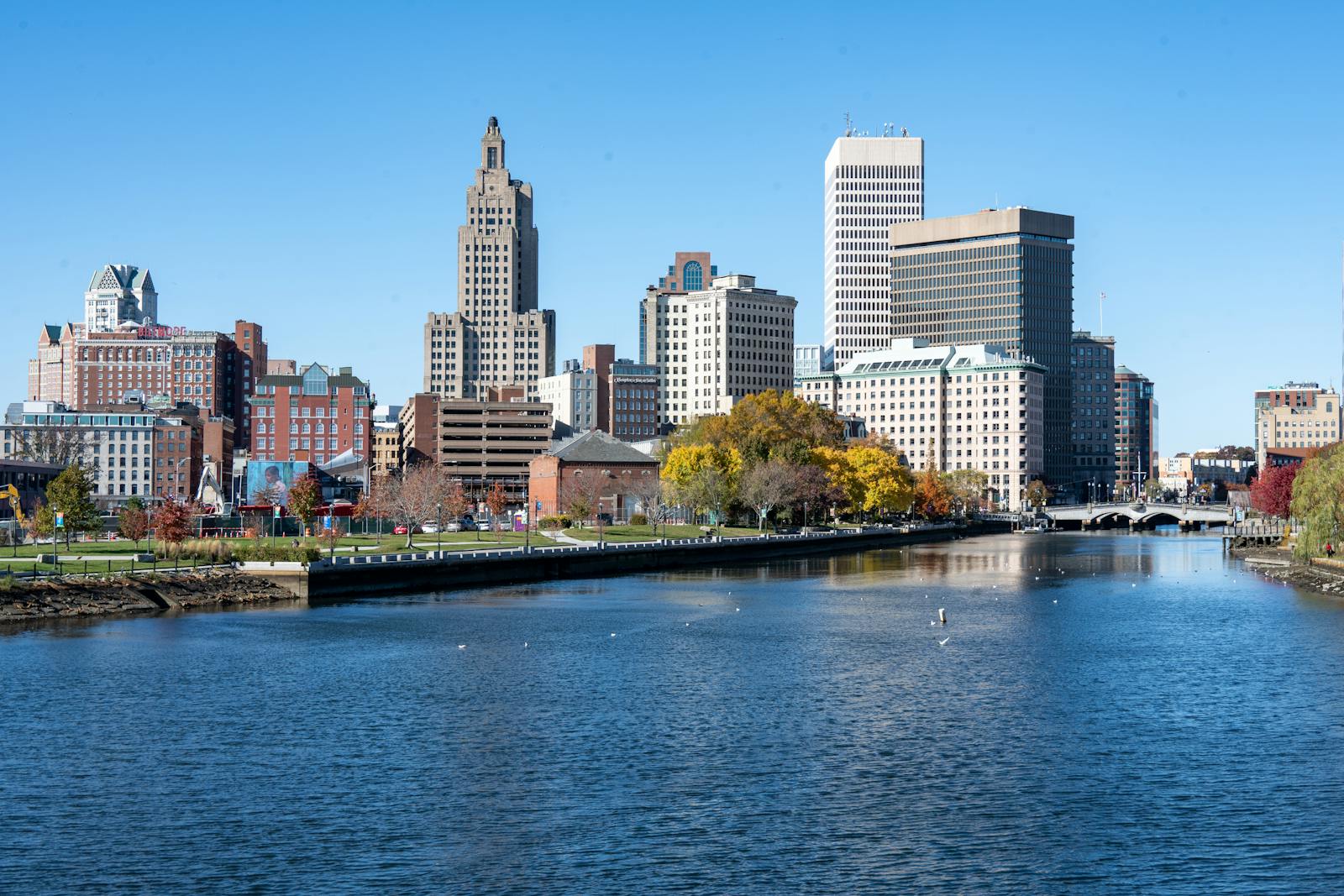
The city that paved its rivers
By the early twentieth century Providence had buried much of its own waterfront. The downtown reach of the Providence River — formed where the Woonasquatucket and Moshassuck rivers meet — had been progressively covered over with bridge, roadway, and rail. The water that had drawn settlement in the first place was no longer something a person downtown could easily see.
Above it sat one of the more unusual structures in the country. Begun in the 1870s and expanded over the following decades, the interconnected spans over the river had grown so wide that the result, the Crawford Street Bridge, measured roughly 1,147 feet across and was listed in the 1988 Guinness Book of World Records as the world's widest bridge. Pavement, not water, defined the heart of the city.
The freight yards compounded the problem. Rail lines and parking cut the downtown off from the land around the State House, leaving a center that worked as a place to pass through rather than to stay.
Capital Center and the uncovered rivers
The turnaround began as a plan to undo that geography. The Capital Center plan, adopted in 1979, called for relocating the railroad tracks, building a new station near the foot of Smith Hill, and freeing the land that the yards had occupied for new development. The wide bridge was substantially taken down in 1982 and replaced with several narrower street bridges, exposing the river again.
From the mid-1980s the rivers themselves were moved. Design and engineering advanced under architect William D. Warner, whose Waterplace plan was completed in 1985, and the Woonasquatucket, Moshassuck, and Providence rivers were rerouted along new channels lined with walkways and crossed by low pedestrian bridges. Ground was broken in 1988, and the full undertaking, including rail relocation and highway work, ran on into the early 2000s at a cost on the order of $169 million.
What a visitor sees today is the result of that engineering rather than an accident of nature: open water running through the center, granite-edged riverwalks, and Waterplace Park, completed in 1994 at the old salt cove. The water is back where the early city had hidden it, by deliberate design.
Saving the old fabric — and its cost
The Renaissance did not invent Providence's interest in its own buildings; it inherited it. The Providence Preservation Society formed in 1956, when demolition threatened eighteenth- and nineteenth-century houses on College Hill. Working with the city and federal officials, it helped produce the 1959 College Hill study — among the first in the country to direct federal urban-renewal money toward keeping old neighborhoods rather than clearing them.
That instinct shaped the downtown revival. Rather than raze the commercial core, the city's planners and preservationists kept its nineteenth-century streetwalls and reused its old buildings, so that the new riverfront opened up beside a largely intact historic center.
Preservation has another, harder side that belongs in the record. In the mid-twentieth century, highway construction and urban renewal cut through Fox Point, the longtime home of Cape Verdean and Portuguese families near the harbor. Construction of Interstate 195, begun in 1956, and the redevelopment that followed displaced hundreds of households — by one count some 300 families — and many moved to East Providence and beyond. The handsome streets a visitor walks today carry that loss as well as their charm.
Theaters, a collective, and the universities
A revived downtown needed reasons to come into it after dark, and three institutions supplied them. Trinity Repertory Company, founded in 1963, settled in 1973 into the former Emery Majestic vaudeville house — now the Lederer Theater Center — and won the 1981 Tony Award for outstanding regional theater. A few blocks away, the 1928 Loew's State movie palace on Weybosset Street was rescued from demolition in 1978 and reopened as the Providence Performing Arts Center, today the city's touring Broadway house.
The grassroots end of the arts economy took shape in 1985, when Umberto Crenca and a small group founded AS220 as an uncensored, unjuried space for artists shut out of more established venues. In 1992 it bought a building on Empire Street and grew into a downtown complex of studios, galleries, stages, and live-work space — often cited as a model for arts-led city revival.
Brown University and the Rhode Island School of Design supplied the rest: students, faculty, and graduates who stayed, along with a steady demand for places to perform, show, and eat. The creative downtown the city now markets rests on that combination of institutions and the people they hold in place.
Crediting the revival without whitewashing it
No account of the era is honest without its signature mayor. Vincent A. "Buddy" Cianci, Jr. led Providence for much of the period and was a relentless promoter of the riverfront, the arts, and the downtown turnaround. He attached his name to the recovery as thoroughly as anyone.
He was also twice forced from office on criminal grounds. His first long tenure ended in 1984 after he pleaded no contest to a felony assault charge. He returned, and in 2002 a federal jury convicted him of racketeering conspiracy in the corruption investigation known as Operation Plunder Dome; he resigned and went to prison.
Both things are true. The civic improvements a visitor enjoys are real and were pushed forward on his watch, and the corruption that ran alongside them was real too. Crediting the renewal does not require pretending the rest away.
Reviewed source trail
- Crawford Street Bridge — Wikipedia — checked 2026-06-23
- Waterplace Park — Wikipedia — checked 2026-06-23
- Providence River Relocation — Rudy Bruner Award — checked 2026-06-23
- Providence Preservation Society — Wikipedia — checked 2026-06-23
- College Hill, Providence — Wikipedia — checked 2026-06-23
- Fox Point, Providence — Wikipedia — checked 2026-06-23
- Trinity Repertory Company — Wikipedia — checked 2026-06-23
- Our History — Providence Performing Arts Center — checked 2026-06-23
- AS220 — Wikipedia — checked 2026-06-23
- Buddy Cianci — Wikipedia — checked 2026-06-23