The city of water and industry
Providence is a city of rivers. The Woonasquatucket and Moshassuck meet downtown to form the Providence River, which opens to Narragansett Bay — the water that explains the city's founding, its commerce, its factories, and its modern revival around Waterplace Park.
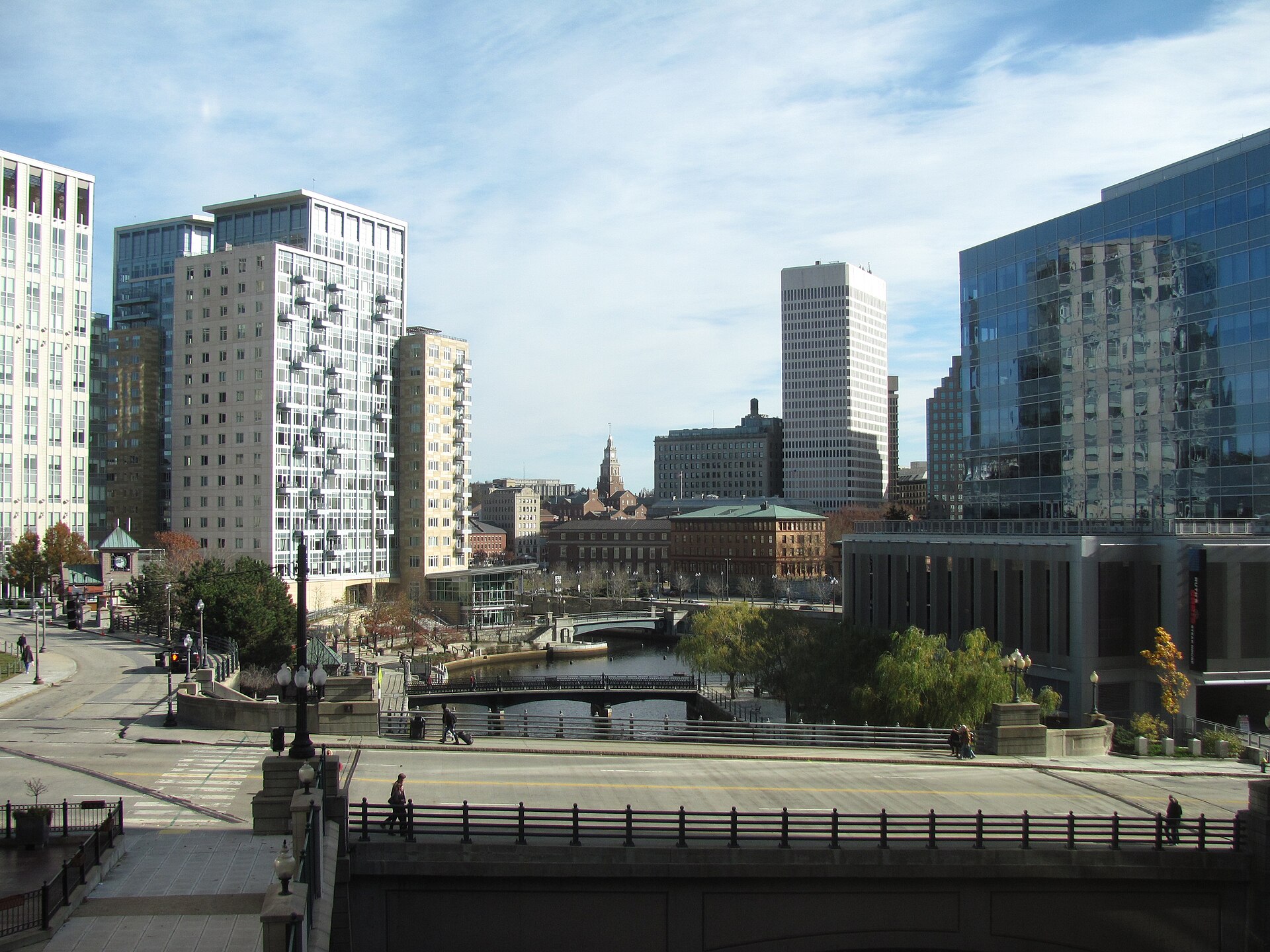
The rivers as the city's body
Two rivers, the Woonasquatucket and the Moshassuck, converge in the center of Providence and form the Providence River, which runs down to the head of Narragansett Bay. That water is not decoration; it explains where the city began and how it grew through trade and industry.
For most of the 20th century the rivers were buried under pavement and parking. Uncovering them again was the central move of the city's late-century revival.
Waterplace Park and the riverfront
Waterplace Park, opened in 1994 on the site of the old Great Salt Cove, returned the rivers to the heart of downtown, with a basin and a Riverwalk of stone bridges and walkways. It is the best place to feel how Providence reconnected with its water.
It is also the setting for WaterFire, the fire-and-music art installation staged on the rivers on select nights — a modern ritual built directly on the city's oldest feature.
The Arcade and the commercial city
Providence was an ambitious commercial town long before its parks. The Arcade, built in 1828, is the oldest indoor shopping arcade in the United States, a Greek Revival landmark that shows a city confident enough to give its marketplace a temple front.
It is a short walk from the rivers, and reading the two together — water and commerce — is the quickest way to understand downtown.
From port to factory
The same rivers powered industry. A few miles north at Pawtucket, Samuel Slater's water-powered mill of 1793 set off the American Industrial Revolution, and the textile, machine, and jewelry trades that followed filled Providence with mills, warehouses, and immigrant working neighborhoods.
Those communities — Irish, Italian, Portuguese, and many more — gave the modern city much of its character, from its Catholic neighborhoods to its food. The move from wharf to factory is one of Providence's defining arcs.
Reviewed source trail
- Greater Providence CVB — Waterplace Park and Riverwalk — checked 2026-06-19
- Rhode Island Department of Environmental Management — Narragansett Bay — checked 2026-06-19
- Blackstone River Valley National Historical Park (NPS) — checked 2026-06-19